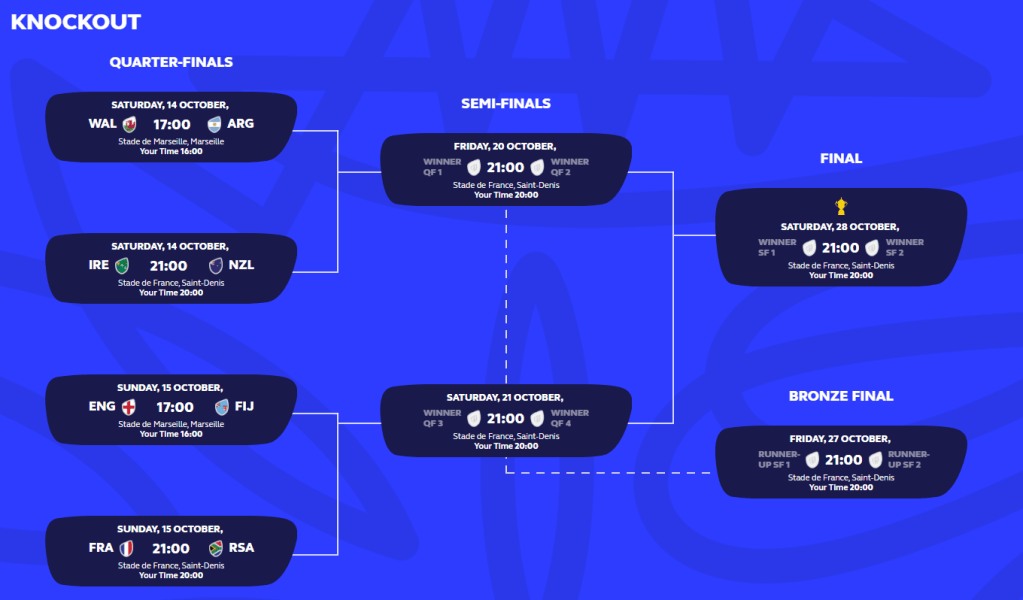
Somehow, it has been a whole month since the Rugby World Cup Opening ceremony. Thirty days on from that fever dream and we finally know which eight teams will be heading into the quarters, and who are already on their way home. Before the tournament began I gave a little bit of a primer on just why this world cup was set to excite, and now as we enter the knockout stages we can review some standout stories of the last month as well as what we have to look forward to over the next few weeks.
I wrote previously about how the opening game between France and New Zealand was a potential final, and if it does end up being a dress rehearsal, then there’s surely no stopping France with their home support. The crowds have been immense, creating pressure cooker atmospheres for both players and referees, who have mostly risen to the challenge of showcasing the sport on the highest stage. Rugby is a game where teams are defined by their style of play, and over the last four weeks we’ve seen some of the most bruising physical rugby from Ireland and South Africa, a drop goal masterclass from George Ford and his England team, plenty of running and attacking flair from the likes of Argentina and Japan, and Damian McKenzie doing his best Harlem Globetrotters impersonation for New Zealand.
It has been a whirlwind of a month, with plenty of tense and exciting matchups, but somehow after forty games played in thirty days, one of the best games was saved for last when Fiji played Portugal on Sunday evening. A clash between two sides who have enraptured neutral supporters over the course of the tournament with their high skill, high speed rugby. Portugal were searching for their first world cup win after falling agonisingly short in the 18-18 draw against Georgia, while Fiji were looking to confirm their place in the knockout stages. The game was an absolute thriller, with the scoreboard leaning one way and then the other, all the way up to last ten minutes where Fiji began to take control of the game with some kicks at goal. Their pragmatism was punished when Raffaele Storti busted down the wing to put Rodrigo Marta in for the final try of the match at 76 minutes, with Samuel Marques adding the conversion to seal a historic win for Portugal.
Portugal have been a delight to watch, and more than deserved their victory, in fact, there’s an argument that they deserved more. A missed penalty against Georgia in the final play of the game robbed them of victory in Toulouse, they made life very difficult for both Wales and Australia earlier in the tournament, and by all accounts easily cut through Ireland’s defences in a behind closed doors warm up prior to the tournament. After such a successful world cup campaign, and a groundswell of support back home, World Rugby has to find a way that pits Portugal and other emerging rugby nations against the higher ranked sides more frequently. It would be inexcusable for Portugal’s story to be put on pause for another four years.
While Portugal have got people thinking about what structural changes will allow emerging rugby nations to flourish, teams still in the tournament are trying to work out how they can innovate to gain an advantage over their opponents. No one has innovated more this tournament than South Africa. Their win over Scotland in week one meant that they were likely to escape the pools, and so were able to experiment with their position-less rugby strategy. Over the course of the tournament they’ve fielded teams with a number of players out of position, restructured their bench and replacement strategy, and also converted a loose forward to a specialist front row position. While not all have worked, their narrow loss to Ireland has been their only stumble, their constant tinkering and experimentation has meant that with the exception of losing Malcolm Marx to injury, they are able to field a team that is stronger now than it was at the beginning of the tournament. They will need to be if they’re going to beat France in their quarter final at the Stade De France. France have progressed through the tournament relatively safely, a big win against New Zealand in the opening game has allowed them to rest and cycle players, but will that mean they show up undercooked and unable to manage the Springbok’s physicality? The other big question hanging over this French side is whether their totemic captain Antoine Dupont will be fit enough for selection after rapidly recovering from the fractured cheekbone he suffered earlier in the tournament. If selected, Dupont will not only get the back line firing, but he’ll also lift and energise the crowd. To win, France will need every advantage they can muster.

Elsewhere in the knockouts, Ireland face New Zealand as they look to continue their run of seventeen consecutive wins. Though the record that will trouble their fans is that they’ve reached eight quarterfinals to date, and never beyond, in their current run of form it would be unthinkable for them to falter again. Ireland are a team of world class players, Bundee Aki has been their standout performer in the tournament so far, but it’s their structured attacking and defensive patterns that have made them a record breaking team. New Zealand on the other hand thrive in unstructured rugby, with each of their players able to create a magic moment out of nothing. Their early loss to France suggested the quarter finals may be their limit, but they have bounced back with emphatic victories over Namibia, Italy, and Uruguay, and will be motivated by revenge after losing their first test series in over a hundred years to Ireland last summer.
Surely, the finalists will be decided by those two games. Due to the nature of the world cup draw the quarter finals set in Marseille will likely be a little underpowered, with any team that makes it through the first round of knockouts arriving at the semi-finals as underdogs. That will be music to the ears of Wales’ head coach Warren Gatland who likes to build a siege mentality around his camp and inspire players to overperform. Wales who had been tipped for an early exit, have taken command of their pool, and bar a narrow win over Fiji have looked comfortable. They face an Argentina side who started slowly against England, but have been steadily building throughout the tournament, and finally hit their stride in a free flowing attacking game against Japan. Wales will need to contain the game breaking wing Mateo Carreras if they have any chance of progressing.
The last quarter final for us to discuss is between Fiji and England, who are both limping into the quarter finals after bruising encounters with Portugal and Samoa respectively. England produced their least convincing victory of the tournament, possibly with an eye on their quarter final. Despite having a team of world cup veterans and a fairly straightforward kick chase game plan, they’re an unsettled team, with no clear starting fifteen, and big questions surrounding who should be their starting outside half. This weekend could be their last chance to get it right, especially if Fiji are able to tidy up some of the handling errors that have cost them throughout the tournament. Fiji suffered a shock loss to Portugal last week that could have seen them eliminated, but fortunately they secured a losing bonus point which kept them in second place. They’ll be looking to recapture some of their earlier form, and will be looking for inspiration from their victory over England in the warm ups. As a neutral’s favourite, expect plenty of support for Fiji in this game as they battle to reach their first ever semi final.
Regardless of each team’s form to date, they will all be thinking the same thing. Three weeks, three games, and three wins is all that separates them from lifting the Web Ellis cup. In knockout rugby anything can happen, and the stage has been set for some titanic clashes and upsets.


 One More Go
Leave a comment