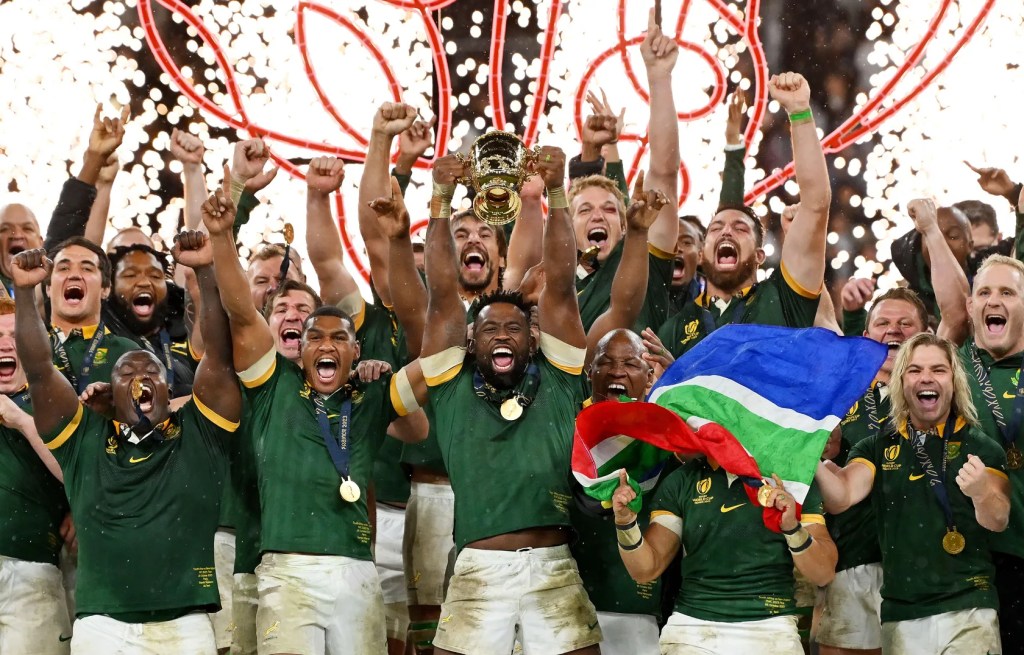
After forty eight matches, one of the most competitive knock out stages in world cup history, and two weekends of torrential rain, South Africa have done it again. They deservedly become world champions for the fourth time, and are now the second team to have won it twice in a row. The only other team, their biggest rivals, and their opponents last weekend, New Zealand. There have been ten tournaments since 1987, and seven of them have been won by either New Zealand or South Africa. At a glance that may paint a poor picture of international rugby and how competitive each tournament has been, but I don’t think it tells us everything, especially when it comes to this most recent World Cup.
Yes, it’s disappointing that two teams who have already won the World Cup were once again in the final, but this year has been the most competitive there has ever been, with four teams turning up as potential winners. South Africa and New Zealand both lost a game in the pool stages, to Ireland and France respectively, the first time ever that both finalists have lost a game. They would then go on to avenge one another in hotly contested quarter finals. The broken spirits and bodies in the aftermath of those matches were testament to how hard it was to win, and how painful it was to lose.
Few would have tipped South Africa as outright favourites at the beginning of the tournament. Not because they are any less capable than New Zealand, France, or Ireland, in fact, they are a better team now than they were in 2019. But so are those other teams, and South Africa found themselves in one of the most physically demanding pools alongside Scotland, Ireland, and Tonga. They were also trying to win their second in a row. Winning one world cup requires plenty of luck, to win two in a row, substantially more, and as the tournament wore on South Africa’s bravery in selection and their innovations around squad depth, mitigated enough risk that they were able to maintain the slightest of leads. South Africa won each of their three knockout matches by a single point, breaking French, English, and Kiwi hearts along the way. The belief and the mental fortitude to achieve that alone, makes them worthy winners, but they’ve also been bold, re-deploying their 7-1 split of forwards and backs for the final, the only team to have ever done so, and then adapting their game plan throughout the tournament by dropping their starting outside-half, and subbing off their star players without hesitation as games were slipping away.

Yes, the games have been tight, but South Africa have earned their wins. That’s not to say that it’s all been plain sailing, there has been plenty of controversies swirling around this Springbok camp, alleged racial slurs, questions raised over head injury assessments, and the substitution of Bongi Mbonambi marked as tactical, when he was clearly injured. Like all the great teams, South Africa live on the edge of legality, they push the rules to their absolute limits in search of victory, and no one embodies this more than their polarizing figurehead Rassie Erasmus. His record speaks for itself, rescuing South Africa from their deepest slump in 2018 to lifting the Web Ellis Cup twice, and a lions series victory in between. In that time he’s also been banned twice for publicly criticising referees, once for publishing an hour long video criticising Nic Berry’s performance during the first Lion’s test, and the second for criticising Wayne Barnes on social media following a loss to France. What you think of all that ultimately depends on if you wear green and gold or not, but there’s no denying that captain Siya Kolisi lifting the trophy for a second time is an inspirational image that will live long beyond the end of this World Cup cycle.
By that metric I think this World Cup has been a success. Over the last seven weeks we’ve seen some of the most compelling rugby, with tense and dramatic matches decided in the final few phases. We’ve seen varying styles played to their absolute best, with epic upsets and agonising defeats, which will have hopefully won the sport some new fans, and maybe even some new players. That being said, there’s still a long way to go before we can say with confidence that the game is growing. Teams like Fiji and Japan are travelling in the right direction, a trend that’s set to continue with their likely inclusion in the new biennial Nations Championship, and while there will be a second division in that competition for developing nations such as Spain or Portugal, we won’t see relegation and promotion come into effect until 2030. The success of these endeavours will be measured at the next World Cup in Australia, a nation in the midst of their own rugby crisis. Balancing support for existing rugby nations on the brink of financial disaster, while also trying to grow the game is no simple task, and it’ll be interesting to see what kind of state rugby is in four years from now. Let’s hope everything becomes a little more stable, and we get to see even a fraction of the rugby that has been on display in France.


 One More Go
Leave a comment