Cyberpunk 2077 is a game about ambition and excess. Set in the world of the Cyberpunk tabletop RPG created by Mike Pondsmith, Cyberpunk 2077 asks you to create and embody V, a street criminal aiming to make a name for themselves. Only the philosophy in Night City is that your name is immortalised by how you die, not by how you live. It’s this attitude that thrusts V into the same social circles as legendary netrunners, corpo executives, and other cyberpunks on their own climb to the top. The opening hours of Cyberpunk are used to familiarise players with the lexicon, teaching the difference between preem chooms and hexed up gonks. Players are introduced to Jackie Welles, another cyberpunk on the ascent, who acts as the connective tissue between players and Night City as together they stumble between poorly conceived and executed jobs on their way to the big time.
While Cyberpunk 2077 is an RPG with its various progression systems, ability trees, and dialogue options, the main way of interacting with the world is firing a gun. Yes, you can spec your character to be stealthier, techier, or create a netrunner who can hack the environment and the enemies’ cybernetics, but no matter the choice, V will almost always face her enemies through crosshairs. The gunplay itself often feels a bit flat, these are the types of firefights where damage numbers pop above enemies, robbing players of the impact and satisfaction of a well aimed shot. That’s not to say the combat encounters are dull. Cyberpunk is at its best when it leans fully into movie mode, channeling players through tightly choreographed sequences leaving just enough slack for players to improvise their way through combat arenas. These are usually reserved for important moments in the narrative, the first of which arrives at the end of Cyberpunk‘s extended introduction as V and Jackie execute a heist at Arasaka tower, the resolution of which launches players into Cyberpunk proper, for better and for worse.

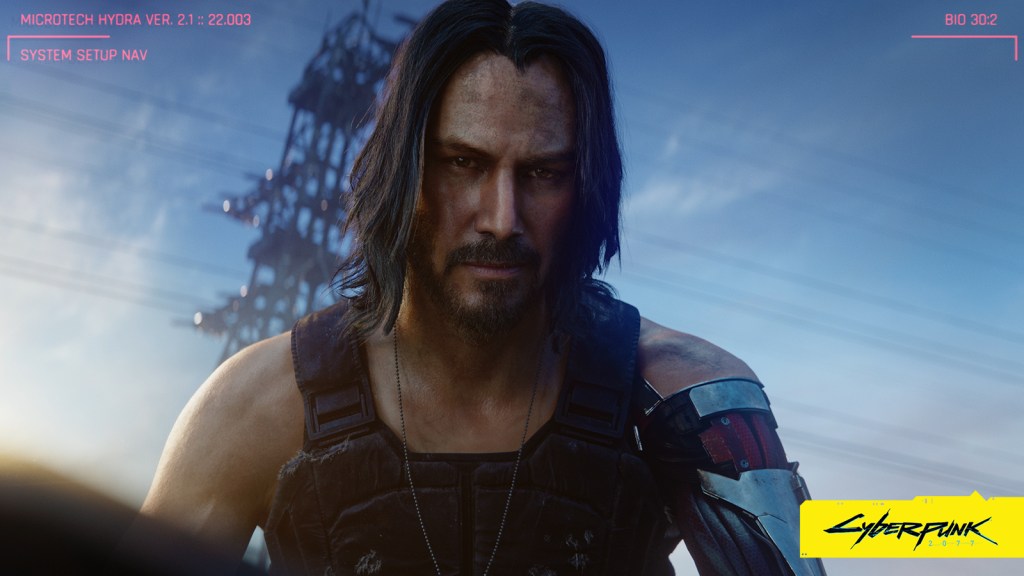
This is where we’re finally introduced to Johnny Silverhand (Keanu Reeves), a legendary figure in the world of Cyberpunk who winds up inside V’s head. Johnny has already made his name, lived the life V wants, and lived long enough to see his impact, or lack thereof. It has an interesting effect on play. Cyberpunk 2077 is crafted in such a way that V’s ambitions are clear, it makes roleplaying the character fairly straightforward, that is, until Johnny is there challenging your every decision, essentially acting as V’s twisted conscience. His dialogue is dripping in cynicism, and Reeves is clearly having a really good time in bringing him to life. Whether V sees Johnny as an inconvenience or an ally to learn from, over time their relationship evolves into one of gaming’s more interesting double acts. Their entanglement leads to some of the games best missions, and better still, their dynamic challenges players to ponder V’s world view, and consider its change throughout the course of Cyberpunk‘s narrative.

Much like V’s chrome addled brain, Cyberpunk is itself torn in two. The one half is its compelling narrative and characters, the other is the open world created to house them. CD Projekt Red have more than earned their open world credentials, The Witcher 3: Wild Hunt is often lauded as having one of the best, but the lessons they learned in designing and populating the sparse wilderness of that world, doesn’t easily translate to Cyberpunk 2077. Night City is much more densely populated, and while some of the locations have an incredible scale to them, the sheer volume of stuff on screen can make it overwhelming. That may be by design, but Night City ends up being an obnoxious cacophony of beautifully rendered colours, sirens, and people, driving away any real desire to get lost in its streets. There are items and gear everywhere to collect, but most of it is left undisturbed as V sprints past, towards the next objective marker. Night City just isn’t a compelling space to explore, partly because it’s brash and dirty, but partly because everything for you to discover is hidden in a bin or an abandoned suitcase, a far cry from stumbling across the hidden treasures strewn throughout The Witcher. On top of that there’s the ‘uncanny valley’-ness of it all. Night City and its denizens are displayed in such fine detail, that their animatronic behaviours and animations are all the more noticeable. Beyond firing your gun in their direction, there’s no real way of interacting with them. They’re extras on a set who, rather than sell the illusion of a living city, just remind you that you’re walking through a noisy sound stage.
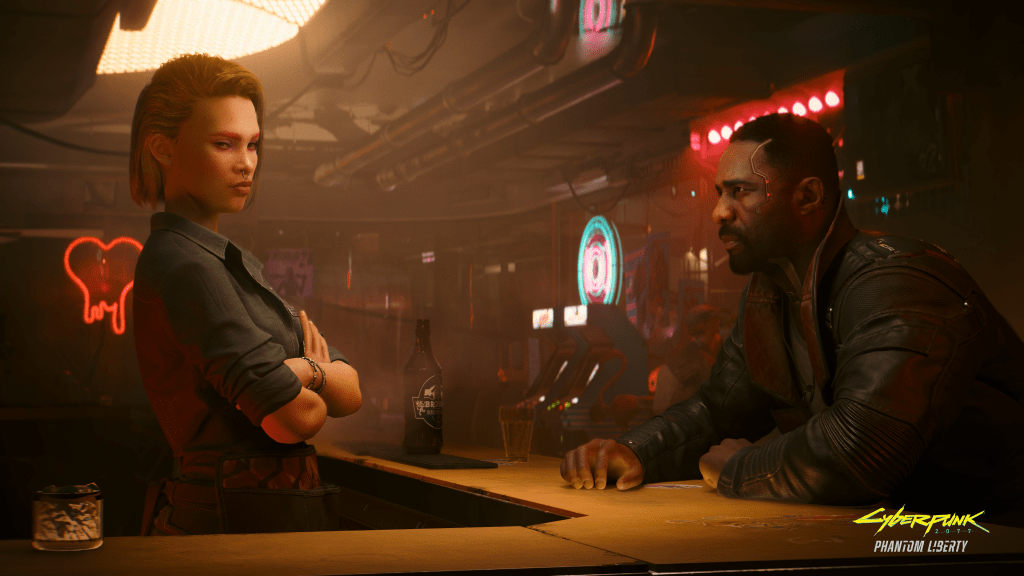
It’s a space that despite being packed full of stuff, winds up feeling hollow. Whether Night City is meant to feel like that, especially as V becomes less tethered by personal connections and more in thrall to her own personal demons, I’m not sure. Whichever way you cut it, the main game only becomes poorer as the intriguing characters introduced early on are sidelined or discarded. Fortunately, Phantom Liberty, a large DLC pack, goes some way to resolve that feeling. Outside of the game’s intro, this is probably the best Cyberpunk 2077 has to offer. Because of its smaller scale, focussed on a single district of Night City, you get to know the geography a little better. Across its narrative arc you fall in with a team, working with them across several missions. Even the district’s fixer, Mr. Hands, has more presence than those featured anywhere else in Night City. That feeling of familiarity works alongside the story to create moral dilemmas for V and Johnny that have more of an impact than those of the main game, leading to an ending that actually sticks the landing. A rarity in games, but even so, it doesn’t feel like enough to justify the tens of hours needed to reach it.
After a lengthy development (first announced in 2012), several delays, a rough launch plagued by performance issues, and another two years of polishing the game to a high standard, Cyberpunk 2077 must be one of the most expensive 6/10s ever made. Not only in the financial costs or the energy expended when developing a game this ambitious, but also in the goodwill CD Projekt Red scorched in the run up to the game’s eventual release in 2020. Since then, countless updates and a significant expansion have made Cyberpunk 2077 into the game it should have been at release, but even so, its long runtime and hollow world design fall short of the game it promised to be.


 One More Go
Leave a comment