
With so many new games launching each month, you may be surprised to learn that in 2023, most of the top 10 games (by average monthly users) were all six years or older. It’s no surprise to see Minecraft, Roblox, and Fortnite all feature on that list, but a title that did catch my eye was Tom Clancy’s Rainbow Six Siege. Released in late 2015, Siege is a co-operative first person hero shooter where teams of five operatives take turns to either attack or defend an objective. Its main point of difference at the time of release was that players could reinforce or destroy walls and floors to suit their strategy, creating new lines of sight or accessways to keep their opponents off balance. Add to that a selection of 20 operatives, each with game breaking abilities, and the result was a game where no two matches were alike.
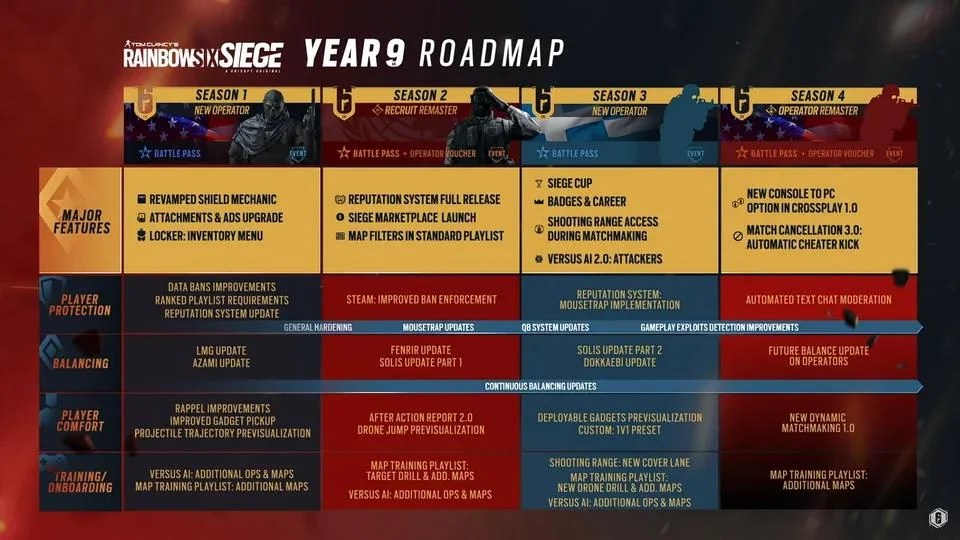
It was an instant hit among my friends, a game where the stories of our reactive strategies often outshone the ones we had spent hours refining. A rogue enemy grenade might open up a defensive flanking route, or a defender’s shield might offer the perfect spot to hide while planting the defuser. It was a game driven by the stories we made, and the joy of recalling them, where the ability to adapt to a situation or outhink an opponent was just as influential to the outcome of a match as the number of kills you scored. Over the next few years we would group up regularly in teams of five, keeping up with the seasonal flow of new maps and operatives. We would devise and adapt strategies as maps and operators were updated, then take them into the ranked ladder, where we were consistently labelled “painfully average”. At some point in Year 5 of Siege’s run we fell away, but with the recent announcement of Year 9’s roadmap, I’ve been pulled back into Siege’s orbit. Curious to see how it copes under the strain of nine years of content, and how I’m able to manage after a four year hiatus.
It’s immediately striking just how much of everything there is now, more maps, new menu screens, new modes meant for training and onboarding new players, three different varieties of loot box, and so many more operatives. From its initial initial roster of 20, Siege now offers 71 operators to select from (36 in attack, and 35 in defense), each with maddening new quirks to stumble upon. At a glance, Ram seems to be the new operator who stands out the most, equipped with a mini tank that can churn up floors, walls, and doors to expose hiding defenders. Then there are the cosmetics, skins to customize the look of your equipment, uniforms and headgear to mix up the look of each operator, and all ranging from bland to absurd. Ubisoft are clearly chasing Fortnite’s lead by adding so many third party uniforms to Siege. Master Chief, 2B, The Mad Dog of Dojima, and Tomb Raider can all be spotted wielding assault rifles and toting shotguns, quite the departure for a game that first sold itself on the tactical realism of siege breaking.

The relatively small roster of competitive maps are unrecognisable too. Walls erected, doors moved, and spawn locations shuffled to ensure that exploring each space feels like wandering a half-forgotten dream, unknown only to the dreamer, as teammates and opponents scatter to enact their strategies. There is a lot to learn, and no wonder that Ubisoft are trying to make it less daunting by adding training modes designed to teach map layouts and recoil control. Another positive onboarding addition is the reputation system, where players can praise or admonish their opponents after each match, or reward players on their own team who stood out for their ability or their guidance. Siege has struggled with toxicity within its player base since launch, at least in my experience of playing on console, so it’s pleasing to see Ubisoft are trying to tackle it head on and create a more welcoming experience for new players.
Despite all that, it can take a while to start feeling competent in Siege. The learning curve is so steep now, and when you’re up against players who can pair their operator selection to each map, it can be tough to even see where the shots are coming from, let alone do anything about them. It’s a tough game, and it can be frustrating, but there is still fun to be found in reclaiming long lost knowledge. On one of my return matches, I used drones to explore an entryway, made my way into the empty room, only for another enemy to blow me up using C4 from the floor below. A trick I would have used myself years earlier. A taste of my own medicine, and a lesson relearnt, one of many over the next few matches. It’s clear that Siege’s glut of new content is both its strength and its weakness. Adding so many options and remixing its map pool undoubtedly keeps existing players engaged, but for new or returning players the volume of required learning can feel insurmountable. Having glimpsed the promise of what Siege offers, I think I’ll stick with it a little while, learn the game from the perspective of one of its new operators, and see whether I can even come close to the middling standards I had set myself years before.


 One More Go
Leave a comment